
Developing a strong governance strategy
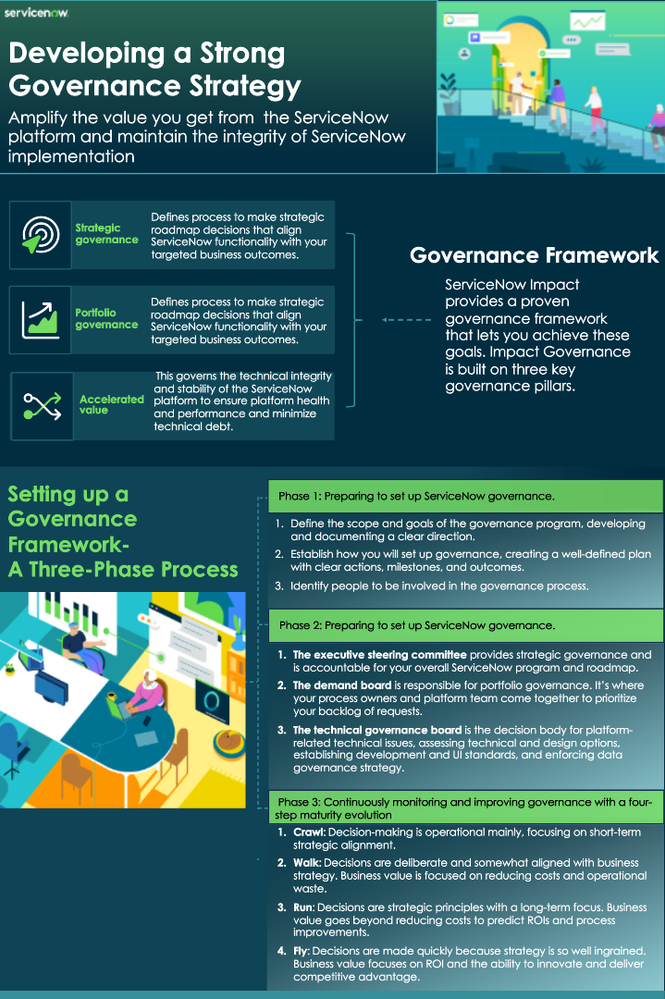
To maximize the value you get out of the ServiceNow platform, it’s critical to have a strong governance strategy. Good governance aligns your investments with your business goals, lets you deliver the right work at the right time by streamlining decisions and removing roadblocks, and ensures you maintain the integrity of your ServiceNow implementation by following technical best practices.
ServiceNow Impact provides a proven governance framework that lets you achieve these goals. Impact Governance is built on three key governance pillars:
- Strategic governance: This defines the process of making strategic roadmap decisions that align ServiceNow functionality with your targeted business outcomes. This is your executive steering committee that sets overall direction, establishes policies, and provides oversight.
- Portfolio governance: This establishes how you make specific portfolio investment decisions based on business needs. Its primary function is to identify, assess, and prioritize demands for functionality you receive from your business stakeholders.
- Technical governance: This governs the technical integrity and stability of the ServiceNow platform, ensuring that you make the right architectural and implementation decisions to keep your platform healthy, maintain platform performance, and minimize technical debt.
How do you set up this governance framework?
The most effective way of establishing strong governance is to follow a three-phase process:
- Prepare to set up ServiceNow governance
- Define and implement your governance processes
- Continuously monitor and improve governance
Let’s look at each of these in more detail.
Phase 1: Preparing to set up ServiceNow governance
Before you actually implement governance, it’s critical to have an established plan. Your ServiceNow platform owner is responsible for doing this. They need to do three key things at this point:
- Define the scope and goals of your governance program, developing and documenting a clear direction that lays the foundation for all of your governance activities.
- Establish how you will set up governance, creating a well-defined plan with clear actions, milestones, and outcomes.
- Identify who needs to be involved in the governance process. This includes executives, leaders within your ServiceNow team, business stakeholders, and key partners.
ServiceNow Impact can help with this step. If you’re an Advanced or Total Impact customer, reach out to your Impact Squad for advice on how to set up Impact Governance leading practices. There are also Impact Accelerators and other useful customer success resources. For example, there’s a Governance Maturity Assessment accelerator that’s available for Total customers, and this workbook takes you step-by-step through this phase as well as the following phases.
Phase 2: Defining and implementing your governance processes
Now that you have a well-defined governance plan in place, it’s time to set up your governance processes. You’ll want to establish three governance boards, reflecting the three governance pillars:
- Executive steering committee: This provides strategic governance and is accountable for your overall ServiceNow program and roadmap. It’s responsible for driving the success of your program by aligning investments with your business goals and delivery capabilities. It’s also responsible for managing program risk and monitoring outcomes to ensure you achieve your targeted benefits.
Typically, steering committee members include your executive sponsor, CIO, platform owner, business unit executives, key partners, and OCM leader. You may also want to include your enterprise architect, PMO leader, compliance and audit leads, and your ServiceNow success architect from your Impact Squad.
- Demand board: This is responsible for portfolio governance. It’s where your process owners and platform team come together to prioritize your backlog of requests from your business, aligning them with your overall roadmap and prioritizing and approving them based on the value they deliver and the effort required to deliver them. The demand board then defines scoped, sequenced packages of work based on these prioritized and approved demands.
The board is led by your demand manager, and it should also include your platform owner, platform architect, process and service owners, appropriate business and domain representatives, program manager or scrum master, appropriate business analysts, and data owner. You may also want to include product owners as guests, as well as your ServiceNow success architect and ServiceNow platform architect from your Impact Squad.
- Technical governance board: As the name says, this board provides technical governance. This is the decision body and gatekeeper for platform-related technical issues, assessing technical and design options, establishing development and UI standards, and enforcing your data governance strategy. You’ll want this board to address environmental topics (e.g. instance structure and management practices), data management (e.g. ownership, quality, security, and integration standards), platform management (e.g. integrity, performance, maintenance and administration, and upgrades), and development management (development standards, integration standards, customization requirements, configuration guidelines, and so on).
Your platform architect should lead this board, and it should include your platform owner, solution architects, platform administrator, solution architects, and appropriate business analysts, as well as development and test/QA leads for each of your projects. You may also want to include your security lead, UX lead, and project managers, as well as your ServiceNow platform architect from your Impact Squad.
Continuously monitoring and improving governance
As with all governance processes, your ServiceNow processes should have established success criteria with measurable outcomes. Identify and track metrics that show you that your governance program is working, and put a program in place to identify, assess, and remove bottlenecks that are getting in your way. At this point, it’s also critical to avoid overloading your governance processes — only deal with the most important issues and push the rest off to the frontlines.
You also need to evolve your governance framework over time. Don’t expect to come in with highly mature governance processes at the beginning unless your organization has already reached a high level of governance maturity. In general, we see customers go through a four-step maturity evolution:
- Crawl: Decision-making is mostly operational and ad hoc, focusing on limited, short-term strategic alignment. There is no mechanism to measure delivered business value.
- Walk: Decisions are deliberate and somewhat aligned with business strategy, which is now focused on the longer-term but limited to key initiatives. Business value is focused on reducing costs and operational waste,
- Run: Decisions are strategic and based on a clear strategy and guiding principles, with the long-term focus expanding to create an enterprise-wide perspective. Business value moves beyond reducing costs to predictable ROIs and measurable process improvements. Financial management also becomes strategic at this point, aligning with a run/grow/transform model.
- Fly: Decisions are made at speed and almost intuitively because strategy is so well ingrained. Similarly, instead of being relatively static, strategy iterates rapidly in response to opportunities and business needs. Business value still focuses on ROI, but also addresses the ability to innovate and deliver competitive advantage. Financially, there’s an increased willingness to take informed investment risks to drive innovation.
Let’s recap
To accelerate the value of your ServiceNow investment, it’s critical to implement a well-defined governance strategy. Impact governance provides a proven governance framework that lets you do this. Addressing the key strategic, portfolio, and technical governance pillars provides a complete approach that you can evolve as your governance maturity increases.
If you want to find out more about Impact governance, this webinar covers what we’ve talked about here in more detail. This webpage also provides useful information, tools, and resources. And don’t forget to talk to your Impact Squad—they’re here to help you succeed.


https://www.servicenow.com/community/servicenow-impact-articles/developing-a-strong-governance-strategy/ta-p/2898418